Eat Sleep Hockey Skate Repeat SVG Review
As a professional embroidery designer and product reviewer, I approach every new digital asset with a critical eye toward its stitch-out potential. When evaluating the Eat Sleep Hockey Skate Repeat Svg, my primary focus is not just on the screen preview, but on how this graphic translates into thread on fabric. For crafters, Etsy sellers, and apparel decorators, the gap between a clean vector file and a high-quality embroidered patch or sweatshirt is where reputation is built or lost. This review breaks down the practical realities of using this ice hockey-themed design in real-world production scenarios.
First Impressions: Visual Rhythm and Stitch Translation
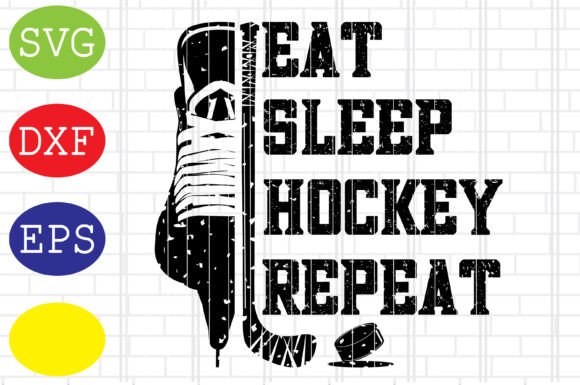
Upon opening the zip file containing the SVG, DXF, JPG, and EPS formats, the layout of Eat Sleep Hockey Skate Repeat Svg immediately suggests a rhythmic, vertical stacking typical of lifestyle branding. The mood is energetic yet structured, capturing the repetitive dedication of winter sports enthusiasts. From a digitizing perspective, this linear arrangement is generally favorable for machine embroidery because it minimizes excessive jump stitches and allows for efficient hooping.
The visual personality strikes a balance between bold athletic typography and illustrative elements like hockey sticks and skates. However, as any experienced digitizer knows, what looks crisp in a vector program can become muddy in satin stitch if the details are too fine. My initial assessment is that this design serves best as a centerpiece for casual wear rather than intricate heirloom work. The graphics appear robust enough to handle standard fill stitch areas, but the text components will require careful evaluation to ensure legibility when converted from pixels to physical stitches.
Real-World Application: Custom Sweatshirt Production
To truly judge this asset, I mentally placed it in a current client project: a custom embroidered sweatshirt for a youth hockey team fundraiser. In this scenario, the Eat Sleep Hockey Skate Repeat Svg needs to perform on heavy cotton fleece, a fabric that can easily swallow small details. The design’s vertical orientation fits perfectly on the center chest or back of a hoodie without distorting the garment's drape.
For this specific handmade product, the repeat nature of the phrase allows for creative color blocking. I envision using team colors for the "Hockey" and "Skate" elements while keeping "Eat," "Sleep," and "Repeat" in neutral white or gray. This application highlights the versatility of the included EPS and SVG files for creating printable mockups before committing to stitching. Customers respond well to seeing a realistic digital preview, and having high-resolution JPGs alongside the cut files makes listing creation significantly faster for small shop owners. The design feels commercially viable here because it targets a passionate niche audience looking for personalized gifts that celebrate their sport identity.
Critical Considerations for Fabric and Hoop Selection
While the design shows promise, there are specific environments where caution is necessary. If you plan to use Eat Sleep Hockey Skate Repeat Svg on performance wear or stretchy synthetic jerseys, you must account for fabric distortion. Athletic knits are unstable, and a design with dense fill stitch areas can cause puckering if the stabilizer choice is inadequate. I strongly recommend testing this embroidery file on a scrap of similar weight fabric before running a full production batch.
Hoop size is another limiting factor. Because the design relies on a stacked text format, resizing it down for a baby onesie or a small cap may compromise the integrity of the lettering. Satin stitch columns have a maximum width limit; scaling down too aggressively turns readable text into indistinguishable blobs. Conversely, scaling up for a large tote bag design might expose gaps in the fill stitch if the original digitization wasn't optimized for larger dimensions. Always verify the native dimensions of the machine embroidery design against your intended hoop size. Additionally, dark fabrics present a challenge; if the design lacks an underlay strategy for light-colored threads on black material, the fabric grain may show through, diminishing the professional finish of the finished product.
Impact on Product Value and Brand Consistency
In the competitive landscape of Crafts and Graphics, the quality of your source assets directly influences buyer trust. Using Eat Sleep Hockey Skate Repeat Svg effectively can elevate a standard piece of custom apparel into a boutique-level item. The clean lines and thematic consistency suggest professionalism, which justifies a higher price point for commercial embroidery projects. When customers see sharp registration and clear text on an embroidered patch or apron, they associate that quality with your brand.
However, poor execution devalues the item instantly. If the hockey stick icons lose definition due to improper density settings, or if the text alignment drifts during stitching, the product looks amateurish. For Etsy sellers, maintaining brand consistency across different products—using the same design on tea towels, pillow covers, and caps—creates a cohesive collection. This design supports that ecosystem well, provided the stitch parameters are respected. It bridges the gap between digital design assets and tangible merchandise, making it a valuable tool for creative entrepreneurs building a winter sports catalog.
Designer Notes for Successful Implementation
Before loading this design into your machine, adhere to these practical guidelines to ensure optimal results:
- Verify File Compatibility: While the package includes SVG, DXF, JPG, and EPS files, confirm that your specific embroidery software or cutting machine accepts these formats for your intended workflow. Not all machines read generic SVGs as stitch files without conversion.
- Test Stitch Density: Run a test sew-out to check if the fill stitch is too dense for your chosen fabric. Heavy density on lightweight cotton causes holes, while low density on fleece looks sparse.
- Check Licensing Terms: Before selling finished items or digital derivatives, review the license agreement included in the zip file. Ensure you have commercial rights for both physical products and digital mockups.
- Evaluate Text Legibility: Inspect the smallest text elements. If the font height is less than 6mm after resizing, consider simplifying the design or removing minor words to maintain clarity.
- Stabilizer Matching: Use cut-away stabilizer for stretchy knits and tear-away for stable woven fabrics. For textured surfaces like terry cloth towels, add a water-soluble topping to prevent stitches from sinking into the pile.
- Mockup Validation: Utilize the included JPG for digital listings, but always photograph your actual stitched sample. Buyers appreciate seeing the real texture and sheen of the thread colors against the fabric.
- Color Contrast Check: Test the design in grayscale to ensure tonal contrast exists independent of color. This ensures readability even when using monochromatic thread schemes.
Final Verdict for Makers and Sellers
The Eat Sleep Hockey Skate Repeat Svg offers a solid foundation for winter sports merchandise, balancing trendy aesthetics with functional layout. Its strength lies in its adaptability across various mediums, from nursery decor to team apparel. Success with this asset depends entirely on the maker's willingness to validate technical specifications against their specific materials and equipment. By treating this graphic as a starting point for customization rather than a plug-and-play solution, designers can produce exceptional handmade products that resonate with hockey fans and stand up to the rigors of daily use. Always prioritize test runs and fabric compatibility to transform this digital download into a profitable, professional-grade embroidery project.